Wednesday, October 27, 2010

Project: Window renewal (#2) - Reprise


Well, we got a good test - 45 hours of hard wind-driven rain, and no leaks.

Hurray!
Share/Bookmark

Tuesday, October 26, 2010

36 hours...

...and counting, of winds 25 - 30 kt
Share/Bookmark

Monday, October 25, 2010

Cruising and self-sufficiency

A recent post over in Boat Bits set me to thinking.

There are those boat owners who proclaim "the only tool I need is my Visa card."   I am not one of those (as you readers of this blog will likely have guessed).  There is nothing inherently wrong with this approach.  But it does mean that these folks are dependent on others, and that boating for them is more expensive.  And home ownership. And automobile ownership.  But, really, that's OK.

But if the boat owner is a cruiser, then maybe this isn't such a good fit.  When you are cruising, you are gone from your home dock for extended periods of time.  You are self-sufficient...
  • You have your own fuel supply 
  • You have your own water supply 
  • You have your own electrical supply 
  • You presumably have enough food and clothing aboard for an extended period
In this circumstance, the boat owner whose only tool is the Visa card will feel  a vague disquiet.  Consciously or unconsciously, he will be thinking, "I sure hope everything keeps working..."  And for him, being at the mercy of  a host of complicated, poorly understood systems will be a fear which will keep him from ever being really comfortable away from the dock.

Now please don't get me wrong.   Those of us who not rely on the Visa card as our primary tool are also hoping that everything keeps working.  In fact, the second question most of us face when we return to the dock after an extended absence is, "How'd it go?", a poorly disguised version of, "What broke?"  And it is a rare trip for which the answer is, "Nothing broke - everything went well!" (everyone turns away, knowing that there are no stories to be told here).  For those of us with tools, spares and skills aboard, the occasional equipment failure does not spell disaster - we really are, after all, self sufficient.  If there were failures, we either repaired them, or MacGyver'ed around them.  They did not spoil the trip for us. 

I would encourage every boat owner to get to know his vessel, intimately.  He should know where every thru hull is (and should exercise them periodically).  He should be familiar with all the wiring.  He should know where all the hoses are and what the purpose of each is.  There should be no place on his vessel that he has not, at least once, personally inspected.  He really should know how all the systems work.

So, where does one get the skills and confidence to be self-sufficient in this way?  It doesn't happen over night.  Mike has a post on Zero To Cruising that perfectly describes the process.  Confidence, and skills, come from experience.  So, get that experience.  The next time you have some kind of failure onboard, resist the temptation to whip out that Visa card, especially if it is a zero cost situation.  Tackle it yourself - consider it to be an education.  Do not be afraid to ask for advice, and even help (although it is pride rather than fear that usually inhibits this).  It has been my experience that those with the skills are more than willing to share them with someone who truly wants to learn.  Each time that you tackle a problem and succeed at it (even if you do it with help), your experience and confidence will grow.

You will become self-sufficient.  And should you experience a failure 1000 miles out of Los Angeles enroute to Hawai'i, you will know the best use for that Visa card:  as a small, thin, plastic shim.
Share/Bookmark

Friday, October 22, 2010

Safety warning: Sealed lead-acid batteries

Scott over at DowneasterYachts.com has posted a graphic warning concerning sealed lead-acid batteries.  Because we feel that safety information should be broadcast as widely as possible, we will repeat it in full here on Windborne.  Please do not take this as a condemnation of this type of battery.  Instead, this is a reminder that there is no ideal type of battery - all choices are compromises.

Here's Scott:
David Gill, new owner of Tondelayo and new member here ran into an interesting situation that is relevant to us here.  As a matter of fact I have 6 AGM batterys on Valkyr.  I like them because you can’t spill acid out of them.  I have had bad problems on a prior boat with that.  However the description here and the photos David provided are very sobering.  I have had 3 AGM batteries in the past that have swollen in a very limited way and went bad.  We had them replaced.  I have had this happen to a couple of west marines SeaVolt AGM group 27 and 31 batteries as well as one of the optima blue top spiral AGM batteries just in the last month.  So this is a very reasonable heads up.  Thank you David for writing this up, and submitting it with the pictures.
Hi Scott.
Here’s a bit of information that may be relevant to anyone using Sealed 12v batteries.  I don’t use them on Tondelayo but anyone who does wouldn’t want this to happen while at sea.

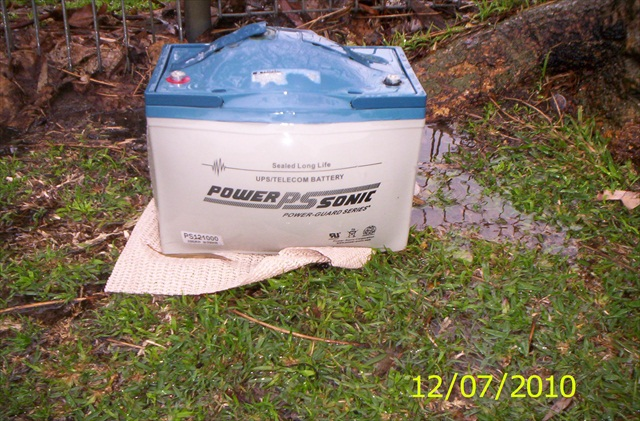
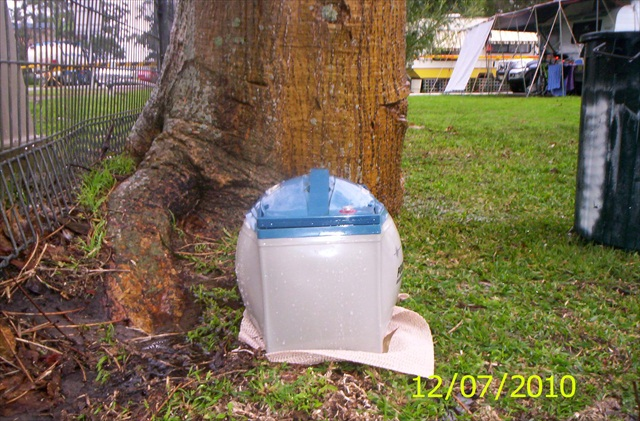
At 0848 hrs on 12 July 2010, pumper 402 Nelson Bay attended a caravan park in Nelson Bay.  On arrival they found a 12V sealed caravan battery (also called Valve Regulated Lead Acid or VRLA battery) with its sides and top markedly bulging.


Park staff had removed the battery from inside a caravan to a grassed area.

The BA team was to cool the battery with spray from a line of 38 mm hose from behind substantial cover. However, the battery slowly continued to expand. Temperature readings taken with a TIC registered 49 ºC.

As it appeared the battery could explode, a hot zone of 30 m and a 50 m exclusion zone were established. A second pumper and hazmat were called to assist.

Accessing the internet from 260 Hazmat’s laptop, a VRLA battery distributor was contacted. They advised to cool with water for the next 24 hours and then disposed of at a regular council battery collection point.

Sustained cooling from substantial cover eventually reduced the battery’s temperature to 26 ºC. After being deemed safe, it was immersed in water and placed in an isolated area of the council waste disposal facility at Port Stephens. The battery’s condition was monitored by council staff and the NSWFB was contacted when the casing broke open two weeks later.

Concerned about the impact that a battery explosion would have in the confined living area of a caravan, SO Kwan submitted an observation to the Lessons Learned Centre. We found that:
  • VRLA batteries are used in a variety of applications. Different types can deliver short duration – high energy output (for starting combustion engines) or release energy more slowly (as power supply backup for telecommunications equipment, etc).
  • They do not need topping up with water. Oxygen evolved at the positive plates recombines with the hydrogen ready to evolve on the negative plates, creating water and preventing water loss.
  • Several conditions can cause the battery to heat up, such as high ambient temperature, poor ventilation, incompatible charging equipment, charger malfunction and battery cell failure.
  • Generally, gas is not produced during charging. However, if a battery is overcharged due to charger malfunction or battery failure, gas pressure can build within the battery. A pressure relief valve is designed to release the excess hydrogen and oxygen.
At the Nelson Bay caravan park, it appears that either the relief valve failed or the heat and gas generated during charging exceeded the valve's capacity. The plastic case softened with the increased temperature and the higher pressure inside caused it to expand. As it cooled, the plastic case became hard and brittle, and eventually broke.

Firefighters are asked to contact FIRU if they encounter expanded VRLA batteries. This will help to research the frequency of this and whether there is a problem with charging units or the batteries themselves.

Regards,
Dave Gill
Mobile: 0488 285 286
Email: davegill@southernphone.com.au

PDF Download
Sobering.  I wonder if our Australian readers can shed any additional light on this incident?
Share/Bookmark
Related Posts Plugin for WordPress, Blogger...