Showing posts with label philosophy. Show all posts

Wednesday, November 6, 2019

Salnick's Fourth Law


Any conversation between boaters will eventually turn to the subject of marine heads.


(See also: Salnick’s First Law
               Salnick’s Second Law
               Salnick’s Third Law
               Adam’s First Law)


Share/Bookmark

Monday, July 23, 2018

Adam’s First Law

Adam’s First Law:
All tools are hammers.
Except screwdrivers - screwdrivers are chisels. 


(See also: Salnick’s First Law
                Salnick’s Second Law
                Salnick’s Third Law)


Share/Bookmark

Monday, July 16, 2018

Salnick’s Third Law


Salnick’s Third Law:


There is no better way to say “I’m retired “
than
“Morning beer.“


(See also: Salnick’s First Law
               Salnick’s Second Law
               Salnick’s Fourth Law
               Adam’s First Law)


Share/Bookmark

Monday, July 9, 2018

Salnick’s Second Law

Salnick’s Second Law:

Nobody ever slept poorly because their anchor was too big.


(See also: Salnick’s First Law
               Salnick’s Third Law
               Salnick’s Fourth Law
               Adam’s First Law)


Share/Bookmark

Monday, February 5, 2018

More Propeller Thoughts

Some time back I did a mind dump of some thinking about boat propellers.  And one of the comments on that post hit a nerve - one that I have been thinking about for years.

Tip vortices.  What are these?  They are the spiraling water that slips off the ends of the prop blades when it is turning.  They come from the fact that water on one side of the prop is at a higher pressure than water on the other side.  This arrangement holds just fine until you get to the end of the blade, and then the high pressure water just spills off the blade and joins the low pressure on the other side, making a vortex.  For visualization, the same thing happens at the ends of an airplane wing, causing sometimes beautiful effects.  And drag.

Wing Tip Vortices

Making vortices uses energy - energy that could have been used to propel water astern giving thrust.  So, how to stop this waste?  On an airplane wing (or a keel...), one way is to put up a fence to stop the spill-over, thus the development of winglets and winged keels.

So what would a fence on a propeller blade look like?
  • Start with a conventional propeller.  
  • Add a ring that goes all the way around the ends of the blades.  
  • Extend the blades profile to meet the ring.  


This is an interesting example - the ring here is being touted as a guard, which of course it is.  But it almost meets the purpose of a fence.  It falls short only in that the ring is not wide enough to fully cover the ends of the prop blades.

Stationary ring bolted to engine
Why doesn't this prop guard achieve the purpose?  In fact, this is probably worse than no ring at all.  The tips will still be forming vortices, which will then immediately impact the (stationary) ring, creating additional turbulence and drag.    It is important that the tips extend to and attach to the ring, and that the ring rotates with the propeller.

Ducted fans have been using (stationary, however) rings forever.  And the cross section of the rings is designed to minimize flow turbulence as the fluid enters the duct (look at the leading edge of a jet engine cowling for an example).  If the rotating ring had such a cross section, drag could be reduced even further.

Now, if only I had a bronze foundry and some propeller tooling to play with...

If someone out there wants  to do the experiment, I need a RH 20x14 prop to fit a 1.25" shaft...


Share/Bookmark

Tuesday, August 29, 2017

Melancholia

I really love getting under way early in the morning!  This morning it was dead calm, the water like glass.  Just a tiny burst of power got Eolian moving out of the slip, ghosting along at far less than a walking pace.  We were moving so slow in fact, that the rudder didn't bite and start to turn her stern until we were well out in the waterway.  A couple of quick bursts in Fwd and Rev (you single screw boaters know what I mean), got her bow pointed down the waterway, and then out of the marina.  A warm, calm, peaceful sunny morning, latté in hand, we left the marina and headed for the Islands.

The melancholy part is, that despite it being a perfect day to be on the water, warm and sunny, this could be the last trip out to the Islands for us this year.  So, in just the same way that you savor the last glorious days of summer when there is a hint of fall in the air telling you, that like everything else, it has to come to an end, the trip across Rosario Strait to Thatcher Pass was filled with not only the enjoyment of a perfect day on the water, but also with the memories we made this summer:

  • Set a new record boat speed:  8.7 kt under yankee alone, in 35+ kt of wind, on our way to Sucia
  • Speaking of Sucia, we ended up making four visits there this year.  It is a magical place...
  • We discovered that going by north of Guemes Island and on to Sucia, one can mostly ignore the tides...
  • We discovered a wind tunnel between Orcas Island and Clark/Barnes islands...  if there is wind anywhere, it will be here...
  • Truly a mountain of crab!
  • The stack-pack I made for the mizzen is wonderful!
  • New friends on s/v Odyssey and m/v Konocti Bay
  • And many, many nites at anchor, throughout the islands.

So...  here I sit, typing away in the last days of summer and the last days of the sailing season for us.  I am endeavoring to be present in each and every moment so that I will have enough days and nites stored away to get me thru the long, wet, dark winter that is inexorably coming...


Share/Bookmark

Saturday, July 15, 2017

An Early Morning Metaphysical Experience


The alarm goes off at 05:30.  The sun isn't up yet, but the sky is light., and the water is dead calm - it's a mirror.
I jump out of bed and throw on my groady sweats.   The crab pots are on the fantail - I prepped them yesterday afternoon.  I get down into the dinghy and Jane lowers them down to me.
And I start the outboard and head toward our Sacred Spot - the one that has yielded so many crabs in years past.  I veer to avoid the other boats - everyone else is sleeping, and our old Sears Gamefisher outboard is noisy.
As I motor along, skimming on a mirror, the sun clears the horizon and floods the world with golden light.  I promise you, there is nothing like being on the water at dawn!
I return to Eolian, the pots set, and I make Jane and I some lattes, and we watch the harbor slowly awake...

Share/Bookmark

Monday, February 27, 2017

Still Thinking...

Design notes
For some reason which is obscure to me,when I am designing something, all my ideas and calculations end up on sticky notes.  This pile is right next to the laptop that I am typing on, right now.  Every design idea I have had on the new mizzen stack-pack is in that pile.  Scary, really.

But sticky notes are not the only tool I use.  For the layout on the fabric (and determining, therefore, how much fabric to order), I used LibreOffice's draw tool, with a scale of 1" = 1':

The order to Sailrite has been made (7 yd of the 46" wide Erin Green fabric, plus a whole bunch of notions: zippers, fasteners, etc). 

And delivered.

Now all I need to get going is weather decent enough to go out and lay out the cuts on the fabric... out on the dock.  Can't do it inside - the panels are 12 feet long.

Waiting for spring...


Share/Bookmark

Monday, January 9, 2017

Stack Pack, Step I: Thinking

 It's cold outside.

Eolian sits in her slip, double-tied and with our additional "winter fenders" as prevention against the winter storms, with temperatures in the 20's, 30's and 40's and winds the same.  It is a time for dreaming, for planning.  (Well, except for the occasional repair, like the lazarette drainage problem which I'll write about some time...).

So what am I thinking about?  I'm designing, in my head, a stack pack sail cover for our mizzen.  I like to have the whole of a project firmly understood, run thru completely in my head...  before I start.  There are always surprises, but this minimizes them.

Why the sail cover?  First, our existing sail cover is shot.  It will make it thru this winter, but the next one is doubtful.  So some kind of sail cover is called for.  But why a stack pack?  I assure you, this not a fashion statement - there is a sound design reason.  Eolian's mizzen boom extends well beyond the stern rail:


Can you imagine putting on a conventional sail cover?  How would you do it?  Well, what this 69-year old man has to do is stand on the stern rail, wrap his right arm over the boom, and with only his left hand reach waaay out there to the end of the boom and single-handedly make up the three Common Sense fasteners on the cover at the end of the boom.  I haven't fallen in the water yet.  Yet.  But my right shoulder has been giving me some trouble of late, and so I can see the end of this procedure coming...  A stack pack solves the "dangling old man" problem.

A stack pack is supported by lazy jacks, which I installed last fall as the first step in this process.  This brings us to the first design issue:  how to actually support the cover with the lazy jack lines.  You might think that this was a "solved" problem.  Not so, by any means.  A walk down E dock showed this:
1. Lazy jacks attached to short straps sewn to the cover

2. Lazy jacks attached directly to the batten thru a grommet in the cover.  Note that there is no provision for adjustment of the lazy jack leg length

3. Openings cut in the batten support tube and lazy jacks tied to the batten

4. Lazy jacks attached to full-length straps sewn to the cover

All of these sail covers were professionally made; all are different.  In each case, I find something that is objectionable:
  • Two sail covers, examples 1 and 4, have the jack lines attach to straps;  the batten provides no vertical support.  Consequently the cover "drapes" around the straps.  Example 4 provides far better support for the cover fabric than does example 1.
  • Example 2 has the jack lines supporting the batten directly, but because of the single grommet hole, there is only a line entry.  I conclude that the line is terminated on the batten internally.  That must mean that there is no provision for adjustment of the jack line lengths.
  • Example 3 also has the jack line support going directly to the batten.  In this case, the lines are tied around the batten which gives good shape to the cover (as in example 2).  However, all jack lines have a forward component to their pull.  As you can see, this has caused the attachment to slide forward against the opening of the fabric and will eventually cause a chafing problem there.

I have decided to use a variation of example 3.  In my case, I will drill a hole in the batten (sched 40 PVC pipe), and pass the jack line end thru that hole.  This fixes its location on the batten and yet provides for adjustment of the jack line length.

In order to make those openings in the cover to admit the jack lines, I will make the cover sides of two pieces of fabric: a side and a top.  If it were a single piece, sewn to make a loop or pocket for the batten (as for example, in the Sailrite design), cutting and finishing the openings out in the middle of a large piece of fabric would be very difficult.  In addition, if the top edge of the sail cover is to have any curve at all (a curved sheer is always more graceful than a straight one...), then the side of the cover and the top must be made of two separate pieces of fabric.

I think I have the seaming details worked out:
  • Cut out the fabric pieces, and then for each side of the cover:
  • Cut out the jack line openings in the top edge of the side piece.
  • Apply finishing binding to the edges of the cut out openings
  • Sew the top surface to the side surface at the top edges, wrong sides together
  • Make a loop or pocket with the stitched seam folding it back against the side piece, leaving sufficient room to slide in the batten pipe.  Stitch it down.
  • Done properly, this should provide lazy jack openings which are finished on all but the bottom edge; the bottom edge is formed by the seam between the side and the top.

See what I mean by "thinking it out?"

OK, now I have to think about the forward and aft ends of the cover and what they will look like...


Share/Bookmark

Monday, November 14, 2016

Random Propeller Thoughts

Eolian's low aspect ratio propeller


I've been thinking about propellers lately.  A lot.


No, I can't explain that.  Perhaps it is a residue of our recent election.  Or something.

Nevertheless...

Now, I am not a trained Naval Architect.  But still, I have thoughts which seem coherent (to me at least, but then the judge may be biased), some brought on by casual observation of a rooster tail following a heavy cruiser.  Even riding on a ferry you can see evidence of a jet of water that eventually surfaces astern.

To me, the whole idea of thinking of a propeller as a water screw is, well, screwed.

Imagine that the that theoretical speed of a boat which would be determined only by the pitch of the prop and its RPM is called St.  In the common parlance, "slippage" - that condition when the boat is moving at less than St, is considered to be an inefficiency.

But imagine that a boat is moving thru the water at exactly St...  there is zero "slippage" - the prop is a perfect screw.  But then the only force on the prop is drag, as it completes its revolutions thru the water.  So how then is any force created* to move the boat forward?

How about this instead:  Newton's Third  Law:  For every action there is an equal and opposite reaction.  Imagine now that the prop's mission in life is to throw as much water astern as it can...  in a sense the boat becomes a rocket, propelled by the water being thrown away aft.  This theory would have as a consequence that "slippage" is required for propulsion.  If the boat reaches St, from the boat's perspective NO water is being thrown aft... NO propulsion.  This also says that a boat will never reach St, because the closer it gets, the less propulsive force is available - a hydraulic version of Zeno's Paradox.

Given a fixed amount of horsepower applied to the shaft, the product of the amount of water discharged and its speed are fixed.  If you want more water discharged, then for a fixed amount of horsepower input, the discharge speed of the water must be decreased.  And vice versa.  So, if you want a high speed discharge jet (high St), you must compromise with less water in the jet.  Therefore, assuming the same Chevy V8 engine, installed in a high-speed racing hydrofoil, you'll need a comparatively small diameter prop with a HUGE pitch.  With that same engine in a tug, a large, slow-turning prop will give you humongous thrust, but with the compromise of a low top speed.  Variable pitch props do not solve the problem because they only allow their pitch to be changed, not their diameter.

What do you need for your boat?  I bet that you want the most speed you can get.  So:  the highest pitch prop that still provides sufficient thrust to get you somewhere near St for that pitch.  Still a guessing game, tho empirical formulae do exist.


*I said that at St there would be no thrust.  That is not (at least theoretically) true.  Since the beginning of flight, aircraft propeller blades have had an airfoil cross section.  That is, they are really rotating wings, not only generating thrust by virtue of their pitch, but also using the pressure differential the airfoil creates between the front of the prop blades and the rear: lift.  An aircraft propeller, even operating at (or above!) St still delivers thrust because of this.  It strikes me that there is a lot of room for hydrodynamic improvement in water propellers, specifically in improving their lift/drag ratios.  Aircraft wings and propellers (and sailboat keels!) long ago gave up the low aspect ratio shape that today's boat propellers still retain.  Continuing with that thought, boat propellers, it would seem to me, would be well served if they moved toward narrow high aspect ratio blades with a cross sectional shape derived from hydrofoils.  Another trade-off:  enough "meat" will need to be retained in those thin blades to handle the thrust forces...


Share/Bookmark

Monday, September 19, 2016

Bittersweet

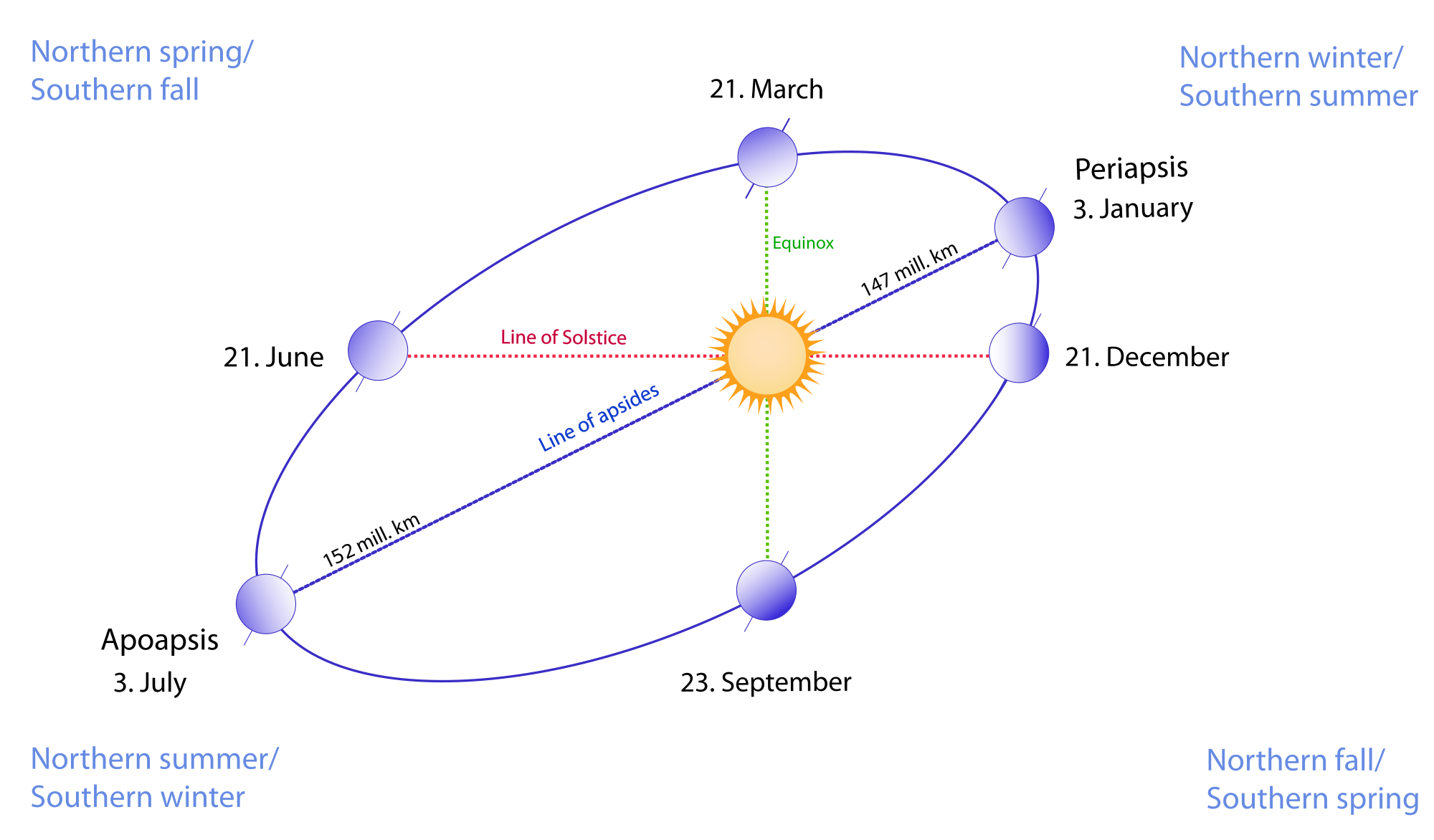
The great wheel of the seasons has turned.  The Earth is now at the 21:00 position in its orbit (yeah, I know it's arbitrary, but that's how I think of it.  Oh, and that the Earth orbits counterclockwise makes my internal vision even more incorrect.)  Day and nite are equal length; sunset and sunrise occur at 06:00 and 18:00 solar time.  Even at noon, the sun is perceptibly lower in the sky.  All the signs are there:  it is Fall.

And looking realistically at what is on our plate for the remaining few nice days of the year, we won't get Eolian off the dock again in 2016.  So, we have brought the winter fenders to the marina and are doubling up our docklines in preparation for the gales of winter, which are sure to come.  I didn't get to diving on the prop to put on a fresh zinc this last weekend because we had the pleasure of running into Grant and Laurie of s/v Shadowdance, old friends from Shilshole...  and let's be honest here...  I didn't really want to jump in the 51° water either.  So I still have that to do.

It was a great year tho, with week after week living at anchor in the San Juan Islands, some spectacular sails, and 50 crabs in the freezer.
Share/Bookmark

Monday, May 2, 2016

Project Recursiveness

Projects on a boat are rarely singular.  Instead, what usually happens is that one project spawns another, or reveals another, or enables another.  Boat projects are recursive.

In the current case, the initial project was not a big one. Our compass binnacle is a beautiful brass construction.  But over time, exposed to the sea air, it takes on, well, a "patina".

Patina
The binnacle is not difficult to remove.  The upper domed section is a slip-on.  With it removed, the compass can be removed by extracting two screws and disconnecting the wires to the nite light.  The four bolts holding the lower cylindrical section are then accessible. 

Now, the project-within-the-project reveals itself.  The small wood shelf that surrounds the steering pedestal has never been refinished since its original installation, many, many years ago.  I didn't do it because I couldn't see how to work around the throttle/gearshift levers.  But with the binnacle removed, it was not much of a step to disconnect the cables and remove the section of the pedestal containing the levers:


Add caption

And so the shelf can be removed...

Project II
I will take this to the shop to strip off the failed Cetol and run a router around the edges to smooth them (the original edge finish used a very small round-over bit and left sharp edges...  and good self-leveling varnish hates sharp edges - it pulls away from them).  I'll reinstall after 6 coats or so of varnish.

In the mean time, a trip to the shop and an hour spent on the buffing wheel, and Project I is complete:

OOooo shiny!


Share/Bookmark

Monday, November 16, 2015

Perspective

We recently returned from a trip to the UK.  Like all times away from home for me, that trip took me out of myself a little, and gave me new perspective.  One of the benefits of travel, I guess.

Parallel history...  what was happening somewhere in the US when...


First of all, 1779 is a common late year that you'd encounter in the UK. Here, this is Iron Bridge - the first bridge to be made of cast iron in the world. Industry sufficiently advanced to create the huge castings this thing required shows just how far things had progressed in the UK.  While the bridge was being built, the Revolutionary War was raging on the US east coast.  And it had been only 3 years since the first western building of any kind had been raised at San Francisco.  It would be 13 years in the future when George Vancouver would bring HMS Discovery into Puget Sound for the first time, making it known to the western world.

But as I said, the 18th century is late times in the UK.  Let's step back a little further, 240 years further back.

Ruins of St. Mary's Abbey, York
In 1539, St. Mary's Abbey in York was destroyed by King Henry VIII (it had been built some 300 years earlier...).  This was only 47 years after Christopher Columbus had chartered three boats from Queen Isabella (obligatory sailing reference, check!) and come ashore for the first time in the West Indies, revealing the existence of the New World.  On the US east coast, west coast, and Puget Sound, First Nations peoples had yet to see westerners.  Longhouses were the architectural pinnacle in North America.


OK, let's step back another couple centuries, to 1312, when one William Binnoch snuck some warriors into Linlithgow castle in a hay wagon to take it for Robert the Bruce (see the movie Braveheart for a visual portrayal of the era, tho not this incident).  Why do I bring this up?  Because Binnoch was a forbear of mine on my mother's side.  For his efforts, Robert the Bruce awarded Binnoch 1000 acres near Linlithgow, at Ecclesmachan.

Ecclesmachan - part of the Binnoch grant
What else was happening in the world then?  The New World was not even Terra Incognita - its existence was not even suspected.  Marco Polo was eleven years from his death and Kublai Khan reigned in the far east.  Saint Thomas Aquinas died some 39 years earlier.


OK, now a bigger step - back to AD 50 when the Romans did their first construction at Bath, site of a natural hot spring in southwestern England.  The Roman Baths are a World Heritage site and are very well managed.

Are those two Roman ladies?
We are now two millenia into the past; the Romans rule the Known World, Christ recently died, and a Roman slave named Spartacus escaped with seventy-seven other prisoners and seized control of nearby Mount Vesuvius.


And finally, this:


The first construction at Stonehenge proper was in about 3000 BC, when a circular ditch about 100 yards in diameter was constructed.  About 500 years later the first of the big stones were raised.  But Stonehenge is not the first prehistoric structure on the Salisbury plain.  Other structures have been dated as early as 3800 BC, and new discoveries in Durington Walls (a couple of miles from Stonehenge) could push this back to 4500 BC - we are approaching the end of the last Ice Age here.

In this period, the city states of Sumer and the kingdom of Egypt were established and grew to prominence. Agriculture spread widely across Eurasia. World population in the course of the millennium doubled, from approximately 7 to 14 million people.  Ötzi the Iceman died near the present-day border between Austria and Italy, and silver was discovered.


This trip made me dizzy - I feel as tho I am standing on the edge of a very high cliff, looking down into the past.  And in Great Britain, that view goes a long, long way down.
Share/Bookmark

Monday, November 2, 2015

Living In Two Places - How To Do It

The Green Bag
From 1997 until 2013 we kept Eolian at the Shilshole Bay marina in Seattle.  During this time she served as our Seattle home because I worked in Seattle.  That meant that the majority of our time was spent onboard, with brief weekend sprints to our log cabin on Camano Island.  Now that I am retired, our time is more evenly split between Eolian (now in Anacortes) and Camano Island.

So, for the last 18 years we have been living in two places.  How does that work?  How do we do it?

First, it takes a lot of organization.  Those of you who know me know that organization is not one of my strong suits, but thankfully, it is Jane's raison d'être.  So what follows here is the system that we have developed to make this work.  Tho in our case it applies to a house and a boat, I imagine it would apply equally as well to the case of two houses (for example, a primary home and a vacation home).

The System

The more self-sufficient you can make each location, the less you will have to shlepp back and forth.  There are limits of course.

In no particular order:
  • Pay your bills in one place; keep all your records in one place.  If you have things in both places, you'll never be sure whether or not you've paid that credit card bill.
  • Have a marshalling location in both places.  That is, a place where things can be collected which need to go to the other location - put things here when you think of them.  This way it is not a giant fire drill when getting ready to leave - things can be accumulated over time.  And then when it is time to pack up, you can be almost certain that nothing has been forgotten.
  • Have a solid, sturdy laundry bag.  It will get dragged back and forth full of dirty clothes going one way and clean clothes going the other.
  • You will need a set of commonly used tools in both locations.  A boat should be well-equipped with tools in any case, in order to be able to handle breakdowns at sea. For seldom-used specialty tools, see The Green Bag.
  • The Green Bag.  The Green Bag always goes with us.  It is a marshalling location for small items.
  • By and large, it works best if grocery shopping is done independently at each location.  Keep a separate grocery list for each location.  This will help prevent, for example, having 3 bottles of ground cumin at each end.  Search for a smartphone app called "Our Groceries" - it allows multiple people to manage a shared grocery list (or multiple lists...).
  • There will always be some food items that need to be transferred, say a partial gallon of milk or some particularly delectable left-overs.  Bag these together and put them in the marshalling location just prior to departure. 
  • You will need a set of commonly used spices in both locations.  For seldom-used specialty spices, see The Green Bag.
  • Have no loose items.  Everything should be bagged if possible.  We make extensive use of those reusable grocery bags that are now so in vogue.
  • Have a formal shutdown process for each end.  Follow it religiously.  In the beginning, it may be necessary to write it down.  After 18 years, not so much.
  • Leave yourself sticky notes to cover unusual circumstances when you think of them - don't try to remember everything at the end when you're packing.  Put them in the marshalling location.
  • Make your cell phone your primary telephone number.
  • Have a single official location for important items that need to travel, such as a checkbook (in our case, this always lives in my briefcase).  Always, always return the item to its official location after use.  If you violate this rule, you will be certain to find yourself at the boat without your prescription sunglasses, for example.
  • Computers are cheap enough now that you can have one at both ends.  But if you are not careful, you computer file systems will be like those two spice drawers...  There will certainly be a collection of directories that you would like to have be in sync on both machines.  Use a cloud service for these, or use a thumb drive to copy these directories back and forth (I use linux - rsync is my friend).
  • Reading material - I have only one word for you here: Kindle.
  • Cell phone chargers and cables are small and cheap - have an adequate number at both ends.
  • Outer gear - keep location specific clothing at each end.  Keep the foulies on the boat and the Carhart chore coat at the house.  If you wear a raincoat to the boat, be sure to put it in the boat marshalling location so that it will go home with you when you leave.
  • Hand projects like knitting should be handled as travelling projects - always prepared to go back and forth.  That is, each should have its own bag and live in it.
So that's how we do it.  Those of you out there who are doing the same thing  have additional suggestions I'm sure...
Share/Bookmark

Monday, October 19, 2015

For Better or For Worse

The great wheel of the seasons turns; the Earth continues inexorably in her orbit around the sun.  To those of us here in the north temperate zones, that means that the boat is put into "winter mode".  For some that means a haulout so that the water can freeze up without the restraint of an interfering hull.  For us in the Pacific Northwest, it means a backup set of docklines and an additional four fenders so that the boat can weather the winter storms safely in her slip.  (And to those of you in the South Pacific and Caribbean... pbbbt!).

This is the time of The List.   It is when we look our vessels over with a (hopefully) jaundiced eye, enumerating all the things that need to be done to have her ready for next spring, and to be in yet better shape than last year.  You see, all of us have taken a Vow with our boats, to protect and support each other in the best of times and in the worst of times.  And this is the time of year when our part of the bargain comes due.

So: The List.  What goes on it?  Well, all the normal seasonal maintenance projects of course.  But do you have a guilty feeling deriving from knowledge that the mizzen spreaders should be replaced?  That there is rot in the bowsprit?  That the primary bilge pump down in the deepest part of the bilge needs a spelunking expedition to repair?  Well these items go on The List.

And sometimes there is something that you want to do as a present to your boat in exchange for the good times she has given you - not something required, but rather as a gift.  Perhaps this could be a radar upgrade (not required, but nice!), or just something for her vanity.

Some of these List items are inside work, and some depend on decent weather to be done.  But they all go on The List.  And it is working down The List which keeps us in mental and emotional contact with our boats over the winter hiatus, and which fuels the dreams of the coming new season with romps under full sail with blue skies and shining water.


Share/Bookmark

Tuesday, October 13, 2015

Bimini Renewal - In Progress

One of the things about owning a boat for a long period of time (or ageing in general, for that matter...) is that you get to see the effects of time.  They are almost never kind.  But to avoid becoming morose, let's keep this focused on Eolian's cockpit canvas.

Way back in 2003 we had our cockpit canvas renewed by Barrett Enclosures in Seattle.  They did a masterful job.  But that was 12 years ago.  In the intervening years, I have had to redo almost all the stitching (because I made a short-sighted decision to use the somewhat less expensive "UV Stabilized" polyester thread instead of the Teflon thread), refresh the Sunbrella's waterproofing on an annual basis, and deal with slow but inevitable fabric shrinkage.  It is a sad thing to me to see the sorry state that things have reached, from such initial beauty.  So, it is  time to do that "once in a lifetime task", a second time.  New cockpit canvas is needed.

But this time, instead of investing more than ℬ6.500, I decided to give it a try myself.  Already having a Sailrite LSZ-1 makes this a possibility.  So I reviewed Sailrite's excellent online videos, ordered a bunch of Sunbrella, fittings, and notions from Sailrite, and set to work.

After uneventfully patterning the aft bimini panel, I encountered the first problem:  There was no place on the boat large enough to lay out the pattern on the cloth.  We were able to get about 3/4 of it on the cabin top, so we did that and then folded the marked section up enough to get room to finish.  Yes, I know that this process was fraught with opportunities for errors to creep in.  But within the tolerance that we were working with (about 1/8") I think we did OK.

But there are a lot of fabric pieces involved in the aft panel.  Altogether 7 more pieces were needed, besides the obvious big one.  And then the space thing reared its head again.  Working with the LSZ-1 on the edge of the saloon table, I was able to sew the long seams by letting the completed section pass over the table and then off the far edge, on its way back to the floor.

On a project like this, fabric management is always difficult, especially when working in a limited space (tho not as big a problem as this).  My recommendation:  always, ALWAYS use  seam-stick tape, 3/8" for normal seams and 1/4" for zippers.  It is a lifesaver.  And don't be in a hurry.

This last weekend, I finally got the last of it done and installed it.  But sadly, somehow I managed to get the locations for the Common Sense fasteners for one of the aft side curtains off slightly.  Rather than make another set of holes in the new piece, I am going to relocate the eyelets in that side curtain instead.  The thinking is that the side curtain is old and will be replaced anyway at a time in the future much nearer than the just-completed panel.  And because of this, I am not going to show you a picture of it.  Yet.

The plan is to move ahead with the other roof panels in sequence - the loose center panel that connects the dodger to the bimini, and then the top panel of the dodger.  When redoing the top panel of the dodger, I will be revising Barrett's design, making the top panel and the front panel separate pieces - the thing is just too unwieldy for me to handle as a unit.  And in fact, it looks like Barrett made the roof and front of the dodger separately, and then stitched them together as a final step.  I will use Common Sense fasteners to hold them together instead of stitching.

So.  I can say at this point, nearly 1/3 done with the top of the bimini and dodger, that with Sailrite's instructional videos, their tools and their materials, this is a doable project.  It is complex and requires constant attention to detail, but it is doable by the cruising sailor, at a savings of 90% over the cost of having a professional do the work.  But don't figure on getting it done over a weekend...


Share/Bookmark

Monday, January 19, 2015

Of Sailing and Gardening


Sailors, it would seem, have little in common with gardeners.  But this time of year, in the Pacific Northwest, they are brothers and sisters under the skin.

It is a time when being outdoors is unpleasant.  It gets dark early, and light late.  It is cold and rainy outside.  For the sailor sitting in an open cockpit or the gardener in ankle-deep soupy mud, it is a time when each wishes that he or she was in a warmer climate.  And so neither ventures forth from their carefully-maintained bubbles of warm dry air.

But we dream.

With cruising guides and seed catalogs we dream of the coming times when the sun will be brighter, warmer.  When the thought of a breeze brings warm thoughts instead of a hood pulled tighter, and green shoots appear to commune with the sun.  Days spent at anchor in a deserted cove and afternoons lovingly coddling tender green plants, tho impossible now, fill our minds.

And so we bring reminders of those coming times indoors to enjoy, and to give us hope.


Share/Bookmark

Monday, October 20, 2014

Time Passes

In 1980 when our kids were just toddlers, I took a picture of this intriguing tree in Washington Park in Anacortes.  It was the occasion of our second trip to the San Juan Islands, and our very first ever boat charter (a Newport 28).

1980

We had occasion to be at Washington Park again this fall, and I was surprised to see that the tree was still there.  But sadly, the intervening 34 years have not been kind to it - tho still in place, it is sagging downward, and it has died.

2014

One other thing is apparent in these two pictures...  the technology of photography has changed dramatically over those years.  The first picture was taken as a 35 mm Kodachrome slide.  The second was a snapshot taken on my iPhone.  Clearly 35 mm format slide film with a 250 mm zoom lens beats the pants off of an iPhone, digitally zoomed out to the max.  Nevertheless, I'll probably never go back to toting around a big heavy camera bag full of expensive lenses.  The convenience of having the camera in my pocket wherever I go is for me an overwhelming advantage.
Share/Bookmark

Monday, October 13, 2014

Sounds

I moved aboard at the end of 1996.  It was the end of the year, so a) I didn't spend much time outside, and b) neither did anyone else...  It was cold, after all.  But as the seasons progressed and the weather warmed, the sounds of spring filled the marina: sanders.  Whenever it wasn't raining, the air was filled with sound of sanders, near and far.  Multiple sanders - on G Dock, F Dock, and even as far away as the nether reaches of E Dock.  People were cleaning up their teak for the annual varnish job.

But times have changed.  It is no longer profitable to mine the dumpsters for scraps of teak - there are none.  And the sound of sanders is gone from the marina.

Now instead what you hear is the whine of the boat detailers' buffers.  Boats no longer have teak on them - it's just too expensive and too hard to keep looking good.  Now they are all white fiberglass, frequently buffed by that detailer's wool pad.

Progress, I guess.


Share/Bookmark

Thursday, September 11, 2014

Nothing stays the same

Me, in the office in 1997
I can't describe it in any other way.

For sixteen and a half years, we had Eolian moored in Seattle.  Because I worked in Seattle, she was our Seattle home (as it said until only recently over there on the right).

Because I worked in Seattle, my work clothes were in the hanging locker on Eolian.  Because we attended church in Seattle, my fancy clothes were in that same hanging locker.  My good shoes, my rain shoes for the winter, my Tevas, my deck shoes were all aboard Eolian.

Yes, we had a log cabin up on Camano Island...  that we visited on weekends, sometimes.  My automotive tools were there, and there was a lot of lawn to mow.  But for all intents and purposes, the cabin was for us a fancy, expensive laundromat, 68 miles away from the marina.

And then I retired.

And then a slip opened up in Anacortes at the Cap Sante marina.

And we moved Eolian from Seattle to Anacortes.

That's a lot of changes.

The net result is kind of paradigm shattering for me...  we no longer class ourselves as liveaboards.  My good clothes are slowly migrating to the cabin.  And pretty soon the only shoes I'll have aboard are my deck shoes.  We leave the boat for a couple of weeks at a time.  And although we have never had a year when we were off the dock as many days as in 2014, there is... a strangeness.  Eolian no longer seems as much like home base.

As I sit here anchored in Blind Bay and typing this, the view from the office looking aft is the same as it was in 1997 when I started chronicling the changes we were making to Eolian.  But now, aside from those improvements, it is different, somehow.

Nothing stays the same forever - there is always change.


OK, I need to put something to rest.  After reading this Jane said, and the comments to this post indicate, that I managed to convey that I am feeling sadness.

NOT SO!

But I am feeling a twinge of nostalgia - fall is a good time for that.  This last year on the boat has been the best one we've had.  I believe that we've done more actual sailing this year than in any of the past 16 years.  And we've been on the boat, away from the dock, 51 days this year so far...  not just short over-nighters to Port Madison, but living at anchor for weeks at a time (he said, typing while at anchor in Blind Bay).
While in the past we provisioned the boat and then set off, we now are staying away from the dock long enough to need to find provisioning while out here.  We are living out here in the San Juan Islands for weeks at a time, not just visiting.     

(Note that none of the above is meant to take away from our month-long trip to Desolation Sound, where we provisioned for and stayed off the dock for the whole month - that was a special circumstance, proving to ourselves, I guess, that both we and the boat had capacities for long-distance cruising.) 

So it is all good!


Share/Bookmark
Related Posts Plugin for WordPress, Blogger...